































There are no more items in your cart
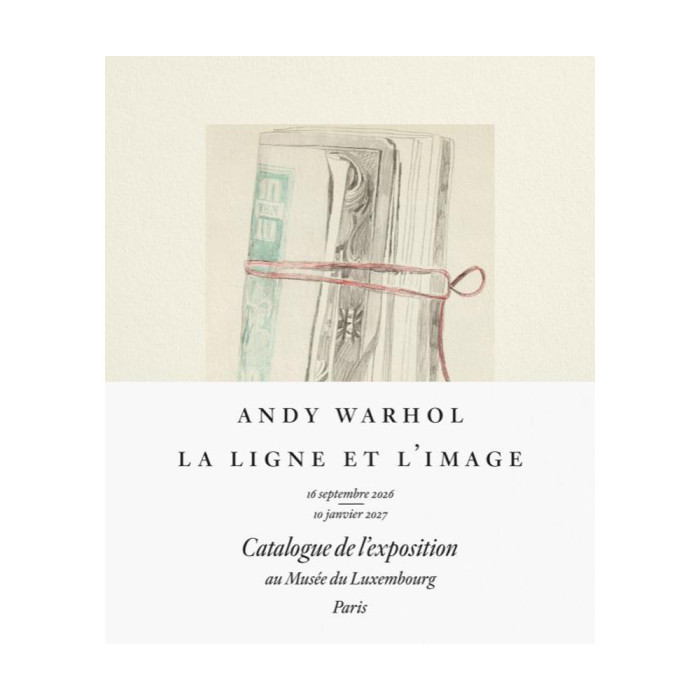

Andy Warhol : La ligne et l'image
€42.75 Tax included
€45.00
| Enjoy 5% off exclusively on our website |


“I want to be a machine”: this famous epigram by Andy Warhol (1928–1987), together with his choice of photo-silkscreen reproduction in the early 1960s, has made us forget that he was first trained in the art of illustration—and, above all, that he continued to draw until his final days, revisiting in new layouts the motifs so often repeated by machine, as though he needed once again to carve out the same furrow with his own hands. Pop Art was indeed invented and perpetuated freehand… Thus, far from being incidental, his drawings are an essential part of Warhol’s conception of his art. And like his paintings, they are often highly spectacular.
From an early Self-Portrait dated 1942 to acrylic drawings related to The Last Supper in 1986, Warhol’s drawn output is as abundant as it is varied. Portraits, caricatures, genre scenes, decorative and advertising plates, self-promotional portfolios: until the end of the 1950s, drawing remained his preferred medium. It was through drawing that he managed to move beyond the influences of Paul Klee, Picasso, Matisse, Cocteau, and Aubrey Beardsley, as well as American artists such as Ben Shahn, Charles Demuth, and Paul Cadmus. It was through drawing that Andrew Warhola became Andy Warhol.
The techniques he developed—stamping, broken lines, transfer lines, stencils, collage, and more—were generally conceived with repetition and reproduction in mind.
Painting, then cinema, fully occupied him between 1963 and 1973. He returned to drawing at that point with different aims, closely linked to his pictorial production, especially commissioned portraits, of which Mao is the prime example. From then on, he used drawing to test certain chromatic, graphic, or conceptual options, very often in large formats that far exceed those of a simple sketch. His drawings are frequently full-scale tests for paintings and have a similar impact.
They highlight his technical inventiveness from the 1950s onward and allow for a reassessment of the question of manual and then mechanical reproduction, particularly by considering his relationship to photography. They also offer an opportunity to examine more precisely the bridges between commercial advertising and high art, and to better understand the development of his various thematic registers. Rare or overlooked drawings and documents provide deeper insight into the making—the Factory—of the work of an artist whose many facets remain to be discovered.
Details
Author: Alain Cueff
Publisher: Réunion des Musées Nationaux
EAN: 9782711882175
Weight: 0.808 kg
ISBN: 2711882179
Number of pages: 208
SKU: 5883372
2872